Model Context Protocol (MCP) vs APIs

Large language models are powerful, but they don’t work in a vacuum. To be genuinely useful, they need to reach outside themselves — pulling in live data, calling tools, and plugging into the software people already use. For decades, the answer to “how do two systems talk to each other” was the API. But in late 2024, Anthropic introduced something built specifically for AI: the Model Context Protocol (MCP). On the surface, MCP and APIs look similar — both let one system talk to another. But the differences point to a real shift in how AI agents will operate.
MCP: One Protocol, Unlimited Integrations

Imagine building an AI agent that needs access to dozens of different tools. Traditionally, each tool comes with its own API, authentication mechanism, SDK, and documentation.

MCP eliminates that complexity by defining a common protocol between AI applications and external services.

  • Host manages the AI workflow.

  • Clients establish connections.

  • Servers expose tools, APIs, databases, and other resources.

As long as both sides support MCP, they can communicate seamlessly without creating a new integration every time.

The Two Things LLMs Actually Need Strip it down, and an LLM asks external systems for two things: 

1. Context — structured information: documents, database rows, knowledge bases. 

2. Tools — actions it can take: search the web, send an email, run a script. MCP covers both through three building blocks: Tools — callable functions, like get_weather or book_meeting . Resources — read-only data, like files, schemas, or config values. Prompt templates — pre-built instructions for common, repeatable tasks. A weather service might expose a get_weather tool. A database server might expose

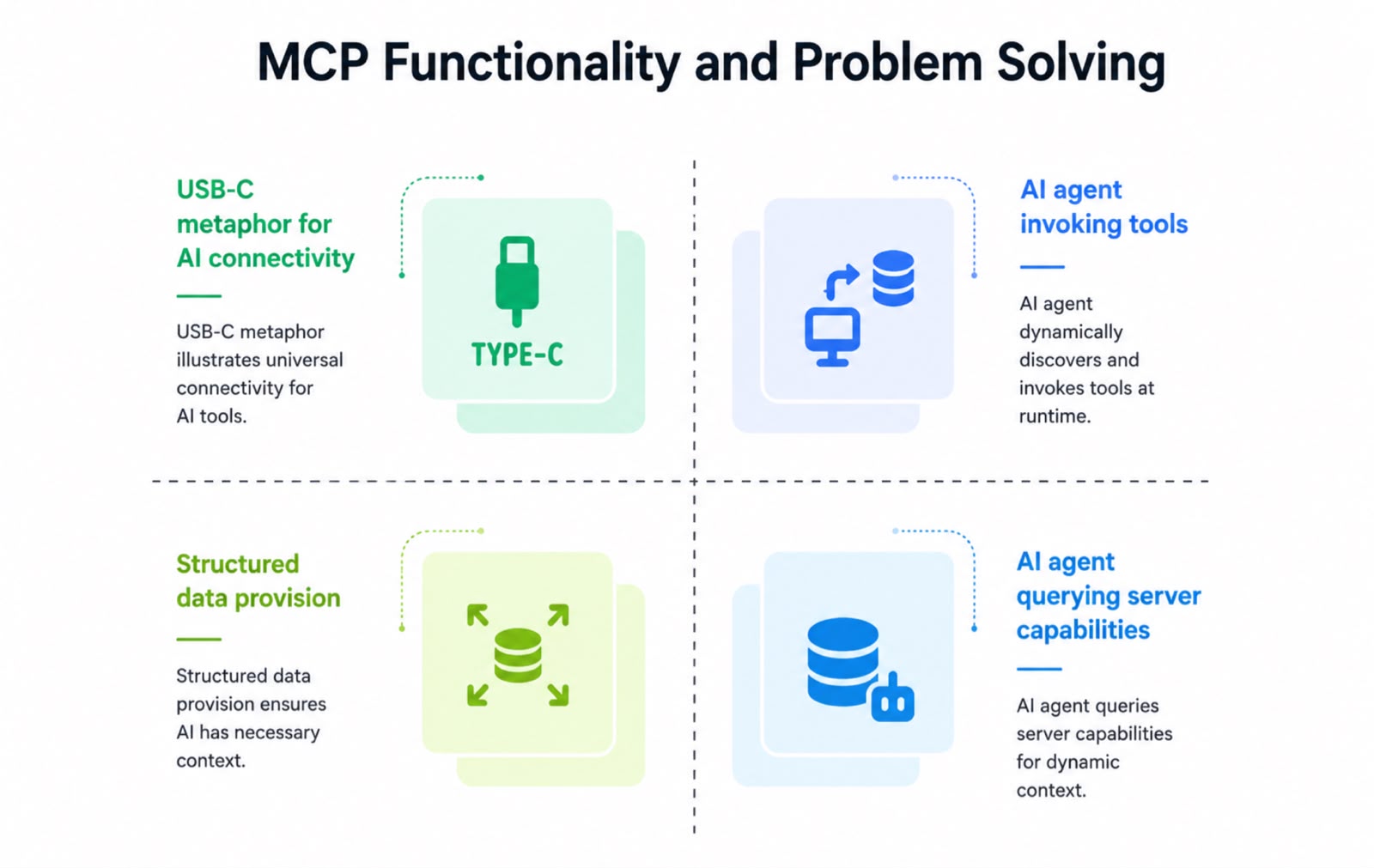
Dynamic discovery is really MCP’s headline feature. Instead of a developer hard-wiring what an AI agent can call, the agent can just ask a running server what it’s capable of, right there in the moment.
Here’s how it plays out:
 
•The client fires off a discovery request — something like tools/list.
•The server answers back with its full menu: what each function does, what inputs it expects, what it returns, plus example usage.
•Armed with that, the AI can start calling those tools immediately — no custom glue code, no manual wiring in advance.
 
This is a fundamentally different model from REST APIs, where any change on the server side means a human has to go update every client that depends on it. With MCP, the server can evolve — add tools, change capabilities — and a compatible agent just adapts on its own the next time it checks in.

Here’s how APIs actually work, and why that’s a problem for AI.

 
REST APIs have been the workhorse of software integration for decades. A typical one:
 
•Relies on HTTP methods — GET, POST, PUT, DELETE.
•Exposes fixed endpoints, like /books/123 or /users.
•Assumes the client already knows the exact request format before it ever makes a call.
 
That model works fine for human developers who can read documentation and hand-wire an integration once. But it breaks down for AI agents. A few reasons why:
 
•No discovery — an API can’t tell you what it does. You have to go read the docs yourself; there’s no way to ask it at runtime.
•No standardization — every API invents its own auth scheme, error format, and data shape, so nothing transfers from one integration to the next.
•Static integration — the moment the API changes, every client built against it is broken until someone manually goes and fixes the code.

Key Differences Between MCP and API s
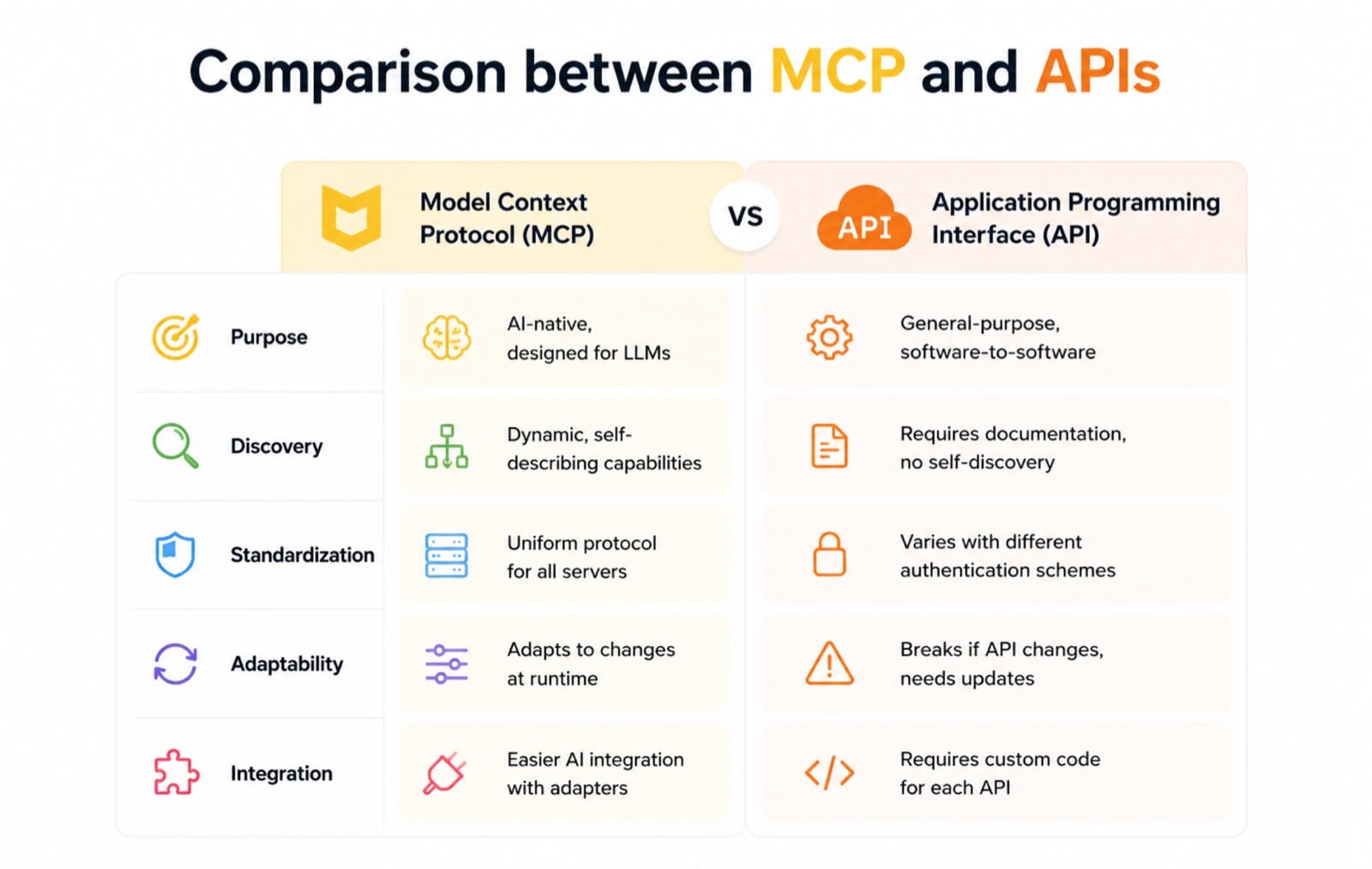
MCP and APIs both connect systems, but the differences matter a lot once AI enters the picture.

 
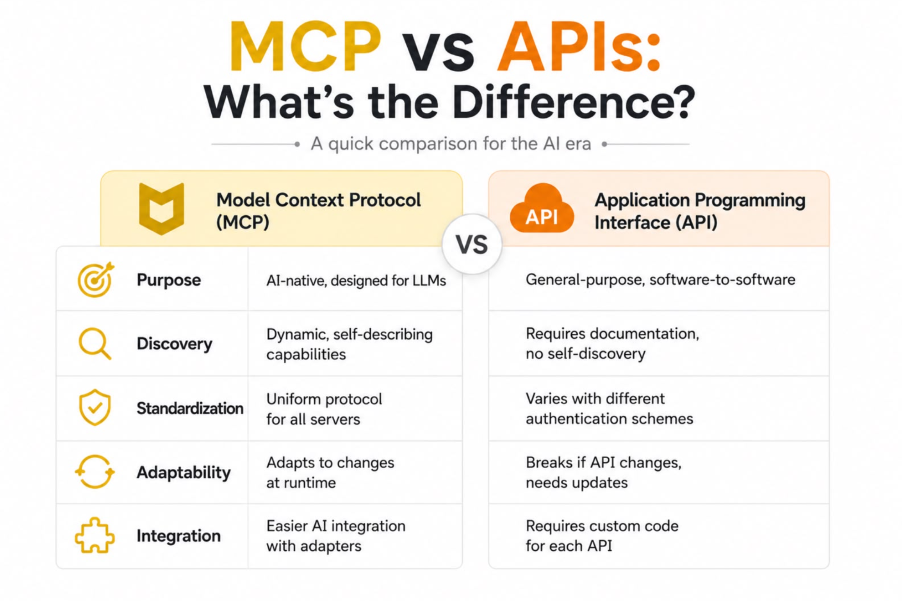
Purpose. APIs are general-purpose — built for software talking to software, with no particular AI in mind. MCP was designed specifically for LLMs, standardizing how they pull in context and use tools.
 
Discovery. A traditional API is silent about its own capabilities; you learn what it does by reading the docs, full stop. MCP inverts that. You can ask an MCP server directly — “what have you got?” — and it hands back a machine-readable list of its tools, inputs, and outputs. The agent adapts to new capabilities on its own, with nothing pre-wired.
 
Standardization. REST APIs are all over the map — OAuth here, API keys there, JSON in one place, XML in another. MCP cuts through that inconsistency: every MCP server speaks the same protocol, so learning to use one means you already know how to use the rest.
 
Adaptability. Change a REST API — add an endpoint, tweak a response shape — and every client breaks until someone patches it. MCP sidesteps this because discovery happens live, at call time. A server can add a new tool, and the agent just picks it up.
 

The twist: MCP often just wraps APIs

Under the hood, a lot of MCP servers are really translation layers sitting on top of APIs that already exist:
 
•An MCP GitHub server might expose repository/list as a tool, while quietly calling GitHub’s own REST API behind the scenes.
•An MCP database server might offer query_table, while actually running SQL or some proprietary protocol underneath.
 
So MCP isn’t killing off APIs — it’s layering something AI-friendly on top of them.
 

Why it’s worth paying attention to

•Simpler integration — one MCP adapter, reusable across AI systems, instead of custom code for every API.
•More adaptive agents — LLMs pick up new capabilities without a developer manually updating anything.
•A real standard — much like USB-C replaced a mess of proprietary chargers, MCP is positioned to replace the current patchwork of ad-hoc AI integrations.
 
MCP already links LLMs to things like Google Maps, Docker, Spotify, and enterprise databases. As AI takes on more real work, it’s shaping up to be the default way models reach into the world.
 
Bottom line: APIs are the old guard — capable, but never built with AI in mind. MCP is the new layer — dynamic, self-describing, AI-native. It’s not replacing APIs so much as making them finally work well for the systems that need to use them autonomously.

Frequently Asked Questions

What is the main problem the Model Context Protocol (MCP) aims to solve for large language models (LLM)s ?

MCP addresses the challenge of LLMs needing to interact with external data sources and tools to be truly useful. It standardises how applications provide context and enable tools for LLMs, particularly AI agents. Before MCP, this interaction typically relied on various application programming interfaces (APIs), which lacked standardisation and dynamic discovery capabilities.

How is MCP similar to and different from traditional Aplication Programming Interface (API) ?

Both MCP and APIs use a client-server model and abstract away low-level implementation details, simplifying integration. However, their primary differences lie in purpose and dynamic discovery. MCP is specifically designed for LLM applications to standardise context provision and tool use, whereas APIs are general-purpose interfaces not tailored for AI. Crucially, MCP supports runtime discovery, allowing clients to query servers about their capabilities, while traditional REST APIs generally lack this dynamic feature.

Can you explain the core components of the MCP using the USB-C analogy provided in the source?

The source uses a USB-C analogy to explain MCP. In this analogy, the MCP host is like the laptop with USB-C ports, the MCP protocol is the standard USB-C connection itself, and the MCP servers are the various peripherals you can plug in, such as a monitor, external drive, or power supply. This highlights how MCP provides a standardised way for AI applications (the host) to connect and interact with different external services or data sources (the servers) using a common protocol.

How does the standardisation offered by MCP benefit AI applications and developers?

The standardisation provided by MCP offers significant benefits. For AI applications, it means they can interact with a wide variety of external data sources and tools using a single, consistent protocol, reducing complexity. For developers, it simplifies the process of integrating LLMs with external services, as they can rely on the MCP standard rather than having to learn the unique endpoints, parameters, and authentication methods of numerous individual APIs. This leads to faster development and easier maintenance.

How does MCP relate to existing APIs, and are they competing technologies?

MCP and existing APIs are not competing technologies; they are complementary layers in the AI stack. Many MCP servers actually wrap existing APIs. This means an MCP server might expose a standardised MCP primitive (like accessing a repository list) while internally translating that MCP call into the native requests required by an underlying REST API (like GitHub’s API). MCP provides an AI-friendly interface on top of the underlying functionality provided by APIs.
Tags: No tags

Add a Comment

Your email address will not be published. Required fields are marked *